Crafting a Blockchain Policy Framework for India
Introduction & Policy Framing
Purpose of This Framework
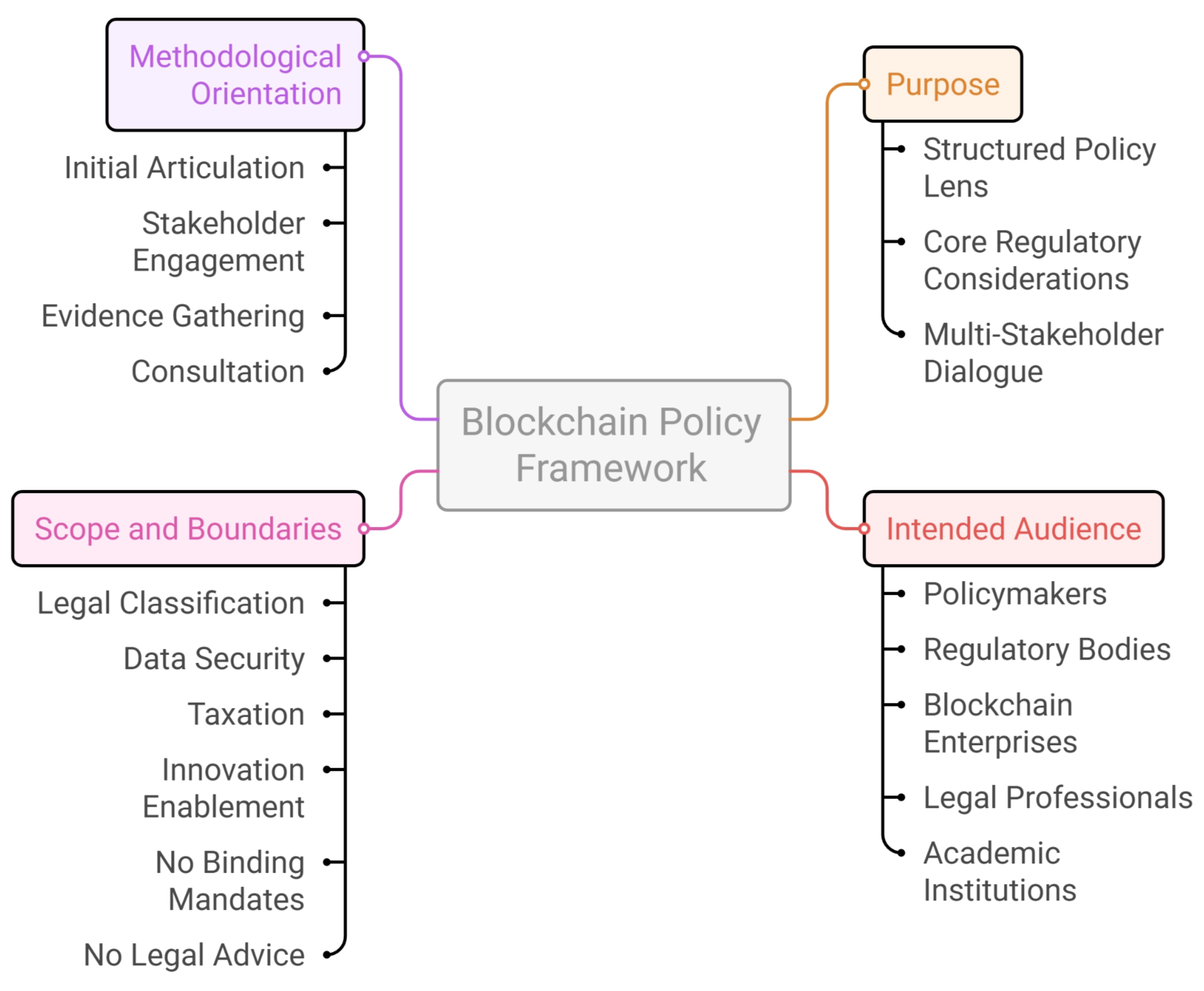
This document presents a draft policy framework intended to support the development of a coherent, adaptive and innovation-enabling approach to blockchain and crypto-related technologies in India. It is designed as an advisory and consultative framework, not as legislation or binding regulation.
The purpose of this framework is threefold:
To articulate a structured policy lens through which blockchain technologies and crypto-related activities can be understood and governed in the Indian context.
To identify core regulatory considerations including legality, data security, taxation and innovation enablement without pre-empting legislative or regulatory authority.
To serve as a foundation for multi-stakeholder dialogue, enabling policymakers, regulators, industry participants, legal experts and civil society to engage with a shared conceptual structure.
This framework is intended to complement existing laws and regulatory instruments, not replace them. It seeks to clarify policy direction where ambiguity currently exists, while preserving the flexibility required for emerging technologies whose use cases, risks and societal impacts continue to evolve.
Intended Audience
This framework is written for a broad but specific audience, including:
Policymakers and government officials involved in digital governance, finance, technology and innovation
Regulatory bodies overseeing financial systems, data protection and consumer protection
Blockchain and Web3 enterprises operating or seeking to operate in India
Legal and policy professionals working on technology regulation
Academic and research institutions studying digital infrastructure and governance
The document is intentionally structured to be readable without deep technical expertise, while remaining sufficiently rigorous to inform policy deliberation.
Scope and Boundaries
This framework addresses policy considerations related to blockchain technologies and crypto-related activities, with a particular focus on:
Legal classification and treatment of crypto assets
Data security, custody and consumer protection concerns
Taxation and compliance considerations
Innovation enablement and regulatory design
It explicitly does not:
Advocate for or against specific crypto assets or platforms
Propose binding regulatory mandates
Provide legal, financial, or investment advice
Replace sector-specific regulations already in force
By clearly defining these boundaries, the framework aims to reduce misinterpretation and ensure that discussions remain focused on policy design rather than market speculation.
Relationship with Existing Legal and Regulatory Frameworks
This draft is intended to operate alongside India’s existing legal and regulatory systems. It does not assume that blockchain or crypto-related activity exists in a legal vacuum. Instead, it recognizes that different aspects of this space may already interact with laws relating to digital records, contracts, financial compliance, data protection, taxation, consumer protection and cross-border transactions.
The purpose of this framework is therefore not to replace existing legal treatment, but to bring greater clarity, consistency and policy direction to areas where current treatment remains fragmented, indirect or difficult to interpret in practice
Methodological Orientation
This draft represents an initial directional articulation, informed by preliminary analysis and global policy discourse. It is explicitly designed to be refined through structured stakeholder engagement, evidence gathering and consultation.
Subsequent stages of this project will:
Validate assumptions through stakeholder input
Identify priority areas based on practical impact
Refine recommendations in line with India's socio-economic realities
India's Digital Governance Trajectory
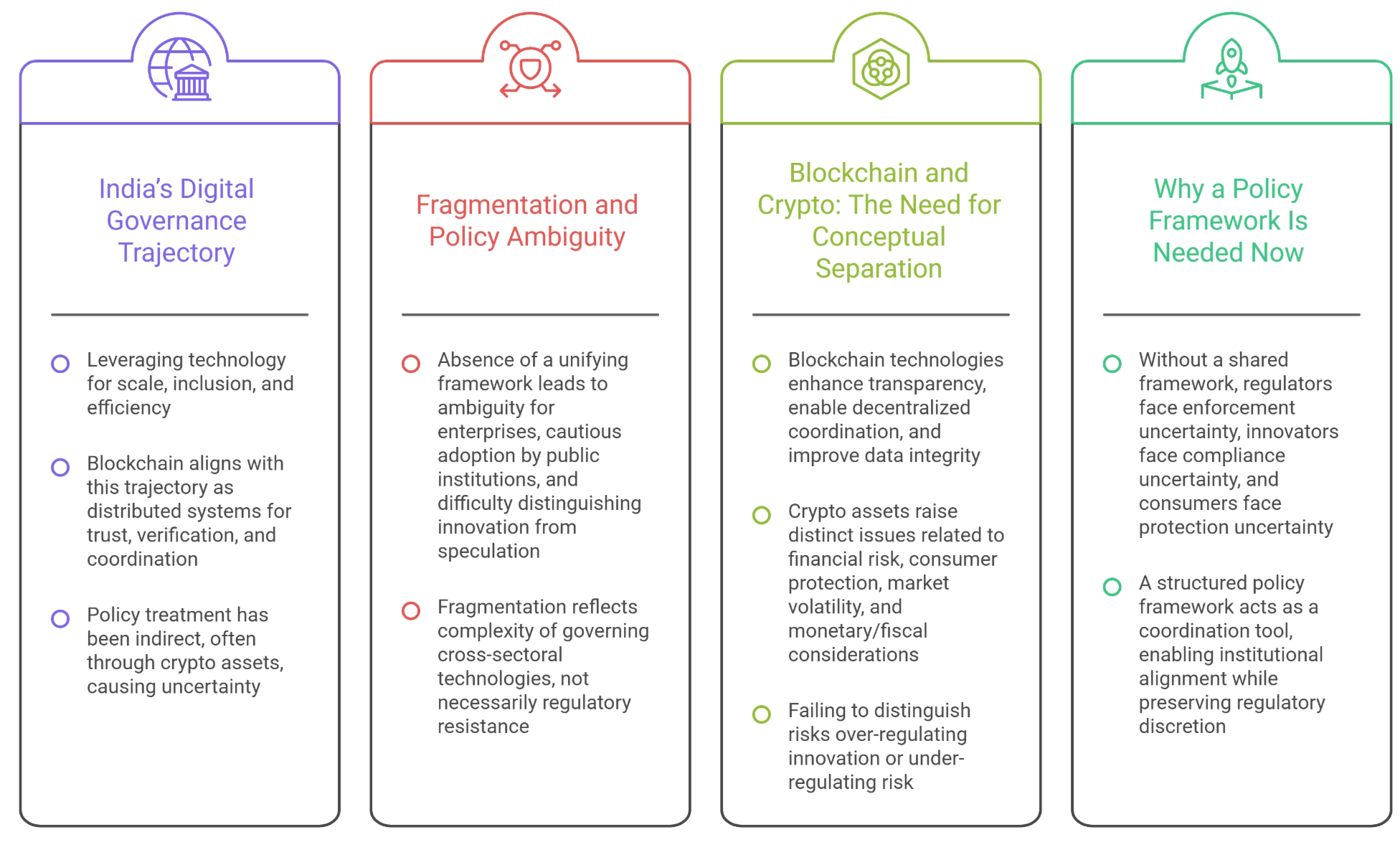
India has, over the past decade, demonstrated a strong commitment to digital public infrastructure, leveraging technology to enable scale, inclusion and efficiency. Initiatives across identity, payments, data governance and service delivery illustrate a governance model that combines technological innovation with public accountability.
Blockchain technologies when understood as distributed systems for trust, verification and coordination align naturally with this trajectory. Their potential applications extend beyond financial instruments to areas such as supply chains, public records, credentials, governance and infrastructure monitoring.
However, the policy treatment of blockchain in India has largely evolved indirectly, often through the lens of crypto assets rather than as a broader technological paradigm. This has contributed to uncertainty in how blockchain-based systems are perceived, regulated and adopted.
Existing Institutional and Legal Foundations
India’s current position should not be understood as a complete absence of legal or institutional readiness. In many ways, the country already has the foundations needed to support responsible blockchain adoption. What is currently missing is not the entire base, but a clearer policy layer that helps connect these foundations in a more coherent way.
This is important because blockchain-related systems do not only raise questions about crypto assets. They also touch on digital infrastructure, records management, trust systems, compliance design, data handling, public administration and cross-border digital activity. A policy framework becomes useful when it helps these issues be understood together, instead of being dealt with in isolation.
India is also at a stage where policy clarity matters for practical reasons. Startups, enterprises, institutions and regulators are all increasingly encountering blockchain-linked models, whether in finance, identity, supply chains, digital governance, or tokenization. In the absence of policy clarity, uncertainty becomes a cost in itself.
Fragmentation and Policy Ambiguity
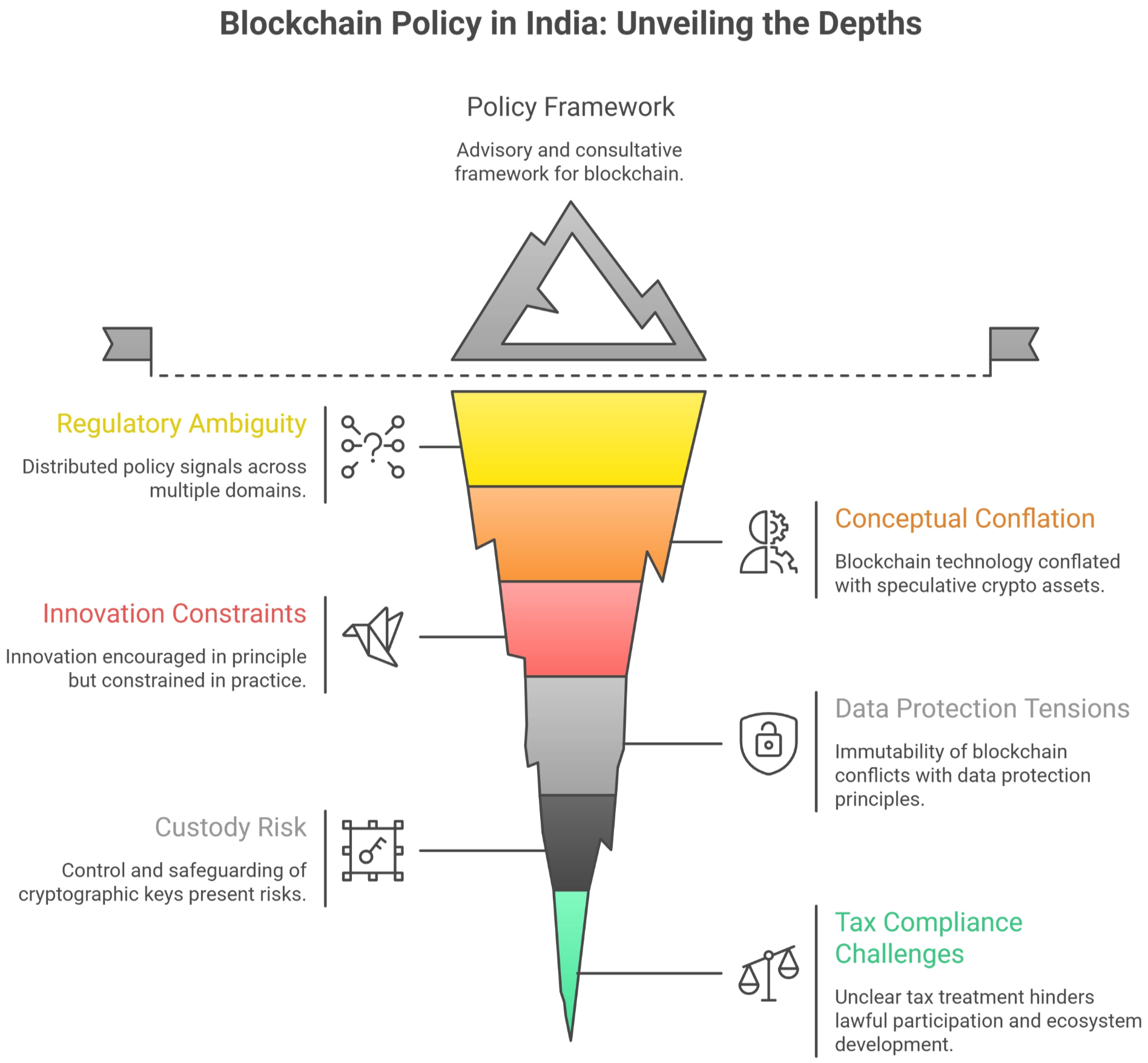
At present, policy signals related to blockchain and crypto-related activities in India are distributed across multiple domains, including finance, information technology, taxation and data protection. While each domain addresses legitimate concerns, the absence of a unifying policy framework has resulted in:
Ambiguity for enterprises seeking to build compliant solutions
Cautious or inconsistent adoption by public institutions
Difficulty distinguishing between high-risk speculative activity and legitimate infrastructure innovation
This fragmentation does not necessarily indicate regulatory resistance, but rather reflects the complexity of governing technologies that cut across traditional sectoral boundaries.
Conceptual Separation of Blockchain and Crypto
A recurring challenge in policy discourse is the conflation of blockchain technology with crypto assets, particularly speculative tokens. While crypto assets are one application of blockchain, they do not represent its full scope.
Blockchain technologies can be used to:
Enhance transparency and auditability
Enable decentralized coordination
Improve data integrity and traceability
Crypto assets, by contrast, raise distinct issues related to:
Financial risk
Consumer protection
Market volatility
Monetary and fiscal considerations
A policy framework that fails to distinguish between these layers risks either over-regulating innovation or under-regulating risk. This framework therefore treats blockchain as an enabling infrastructure and crypto assets as a specific category of activity requiring tailored regulatory consideration.
This distinction is not only conceptual. It has practical consequences. If blockchain infrastructure and crypto-market activity are treated as the same thing, policy may end up creating confusion for both regulators and innovators. Legitimate infrastructure use cases may face avoidable hesitation, while genuinely risky market activity may not receive the kind of focused oversight it requires.
A clearer separation allows policy to be more balanced. It makes space for useful experimentation and responsible development, while also allowing stronger attention where financial risk, consumer harm or systemic concerns are more likely to arise.
Why a Policy Framework Is Needed Now
The absence of clear policy direction creates a paradox: innovation is encouraged in principle, but constrained in practice.
Without a shared policy framework:
Regulators face uncertainty in enforcement priorities
Innovators face uncertainty in compliance expectations
Consumers face uncertainty in protections and recourse
A structured policy framework can act as a coordination tool, enabling alignment across institutions while preserving regulatory discretion.
Guiding Principles

The following foundational principles inform the rest of the framework. These principles are not prescriptive rules; rather, they function as policy anchors to guide decision-making across regulatory contexts.
Technology Neutrality
Policy should focus on outcomes and risks, not on specific technologies or implementations. Technology-neutral approaches reduce the risk of premature obsolescence and allow regulatory frameworks to remain relevant as systems evolve.
For blockchain, this implies regulating:
Activities rather than architectures
Impacts rather than mechanisms
Risk-Proportionate Regulation
Not all blockchain-based activities carry the same level of risk. A risk-proportionate approach recognizes that:
Infrastructure experimentation differs from financial intermediation
Public-interest use cases differ from speculative markets
Regulatory intensity should therefore scale with actual and potential harm, rather than applying uniform constraints across diverse use cases.
Functional Equivalence and Regulatory Consistency
Where two activities create similar economic effects or similar risks, they should not be treated very differently simply because one uses blockchain and the other does not. Policy should look at what the activity actually does, who is exposed to risk, and where responsibility sits.
This approach helps avoid both over-regulation and under-regulation. It supports consistency, reduces loopholes, and ensures that policy remains fair across changing technological models.
Innovation Enablement
Regulation should aim not only to control risk, but also to enable responsible innovation. This includes:
Providing clarity for compliant experimentation
Reducing uncertainty for early-stage enterprises
Encouraging domestic capability building
Innovation enablement does not imply deregulation; it implies intelligent regulation.
Consumer and Public Interest Protection
Policy must prioritize:
Transparency
Accountability
Data protection
Clear grievance and redress mechanisms
Blockchain systems, particularly those involving crypto assets, can shift responsibility toward users. Policy must therefore ensure that risk is not unfairly externalized onto individuals.
Legal Clarity and Predictability
Ambiguity is itself a regulatory cost. Clear definitions, consistent classifications and predictable compliance pathways enable:
Better enforcement
Better compliance
Better outcomes
Legal clarity benefits regulators and innovators alike.
Accountability Despite Decentralization
Decentralization should not automatically mean absence of responsibility. Even in systems that are presented as decentralized, there may still be actors exercising meaningful influence through governance, infrastructure control, custody arrangements, protocol design, user interfaces, or service delivery.
A sound policy approach should therefore focus on where real control, influence or dependency exists in practice. This allows accountability to be preserved without forcing every blockchain-based system into traditional legal categories.
Adaptive and Iterative Governance
Given the pace of technological change, blockchain policy must be adaptive by design. This includes:
Periodic review mechanisms
Pilot-led learning
Ongoing stakeholder engagement
Static policy in a dynamic domain risks rapid irrelevance.
Stakeholder Perspectives
A summary of stakeholder feedback on this section, reviewed by the policy team.
Crypto Asset Legality & Classification
Why Legal Classification Matters
Crypto assets represent one of the most visible and contested applications of blockchain technology. Their treatment within a policy framework is consequential not only for market participants, but also for regulators, financial institutions and consumers.
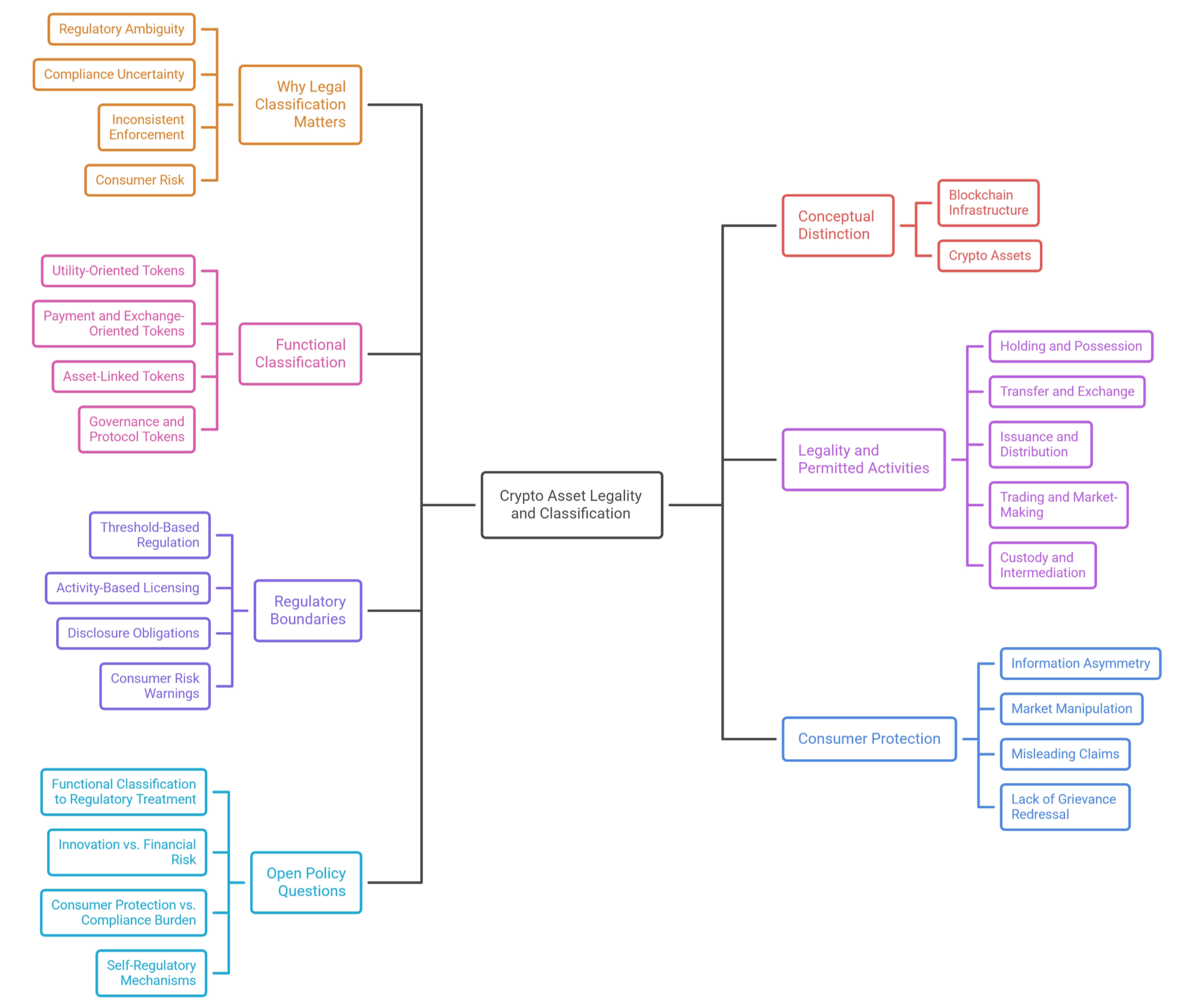
At present, uncertainty around the legal nature and classification of crypto assets creates several challenges:
Regulatory ambiguity, making it difficult to determine applicable laws and oversight responsibilities
Compliance uncertainty for enterprises and intermediaries
Inconsistent enforcement, due to the absence of clear categorization
Consumer risk, arising from unclear rights, responsibilities and protections
A policy framework that does not address classification risks either overgeneralization treating all crypto assets as uniformly risky or under-specification, leaving significant gaps in governance.
This section therefore explores directional approaches to classification and legality, with the aim of supporting clarity while preserving regulatory discretion.
Conceptual Distinction: Crypto Assets vs Underlying Technology
As established in earlier sections, blockchain technology and crypto assets operate at different conceptual layers.
Blockchain functions as a distributed infrastructure enabling verification, coordination and record-keeping.
Crypto assets represent digital instruments created, issued, or transacted using such infrastructure.
Policy clarity requires that crypto assets be evaluated based on their function, use and risk profile, rather than solely on the technology used to create them.
This distinction is critical to ensure that:
Legitimate blockchain infrastructure development is not unintentionally constrained
Regulatory attention is appropriately focused on activities that pose financial, consumer, or systemic risk
Functional Classification of Crypto Assets (Directional)
Rather than a single blanket category, crypto assets can be viewed through a functional classification lens. This framework does not propose definitive legal categories, but outlines commonly observed functional types for policy consideration.
Utility-Oriented Tokens
Utility-oriented tokens are typically designed to provide access to a service, platform, or network functionality.
Indicative characteristics may include:
Use within a defined ecosystem
Limited or no claims on profits, dividends, or governance rights
Primary purpose linked to consumption rather than investment
From a policy perspective, such tokens may raise issues related to:
Consumer disclosure
Misrepresentation of utility
Secondary market behavior
However, their risk profile may differ substantially from financial instruments.
Payment and Exchange-Oriented Tokens
Some crypto assets are primarily used as means of exchange, stores of value, or payment instruments within digital or cross-border contexts.
Policy considerations in this category may include:
Volatility and consumer exposure
Interaction with existing payment systems
Anti-money laundering and counter-terrorism financing obligations
The treatment of such tokens often intersects with financial regulation, even when they are not formally recognized as legal tender.
Asset-Linked or Value-Referenced Tokens
Certain crypto assets derive their value from linkage to:
Fiat currencies
Commodities
Other financial or real-world assets
These tokens may present heightened regulatory considerations, including:
Reserve backing and transparency
Redemption rights
Systemic risk if widely adopted
Policy frameworks may need to assess whether such instruments functionally resemble existing regulated products, without assuming equivalence in all cases.
Tokenised Claims on Real-World or Regulated Assets
A separate category may also arise where blockchain-based tokens represent or relate to claims connected to real-world or regulated assets. These may include tokenised interests linked to financial products, commodities, revenue streams, or other underlying assets that already sit within recognised legal or commercial frameworks.
From a policy perspective, such arrangements may require closer scrutiny than ordinary crypto assets because the token is not functioning only as a digital instrument within a network. It may also reflect rights, expectations, or claims that connect more directly with existing regulated activity. In such cases, the policy question is not only about the token itself, but also about the underlying asset, the rights attached to it, and the manner in which it is offered, managed or transferred.
Governance and Protocol Tokens
Some crypto assets confer governance rights within decentralized protocols, allowing holders to participate in decision-making related to system rules or upgrades.
Policy questions here may include:
Nature of governance authority
Accountability mechanisms
Disclosure of decision-making power and risks
These tokens challenge traditional regulatory categories and may require context-sensitive evaluation.
Legality and Permitted Activities: A Directional Approach
Rather than framing legality as a binary question legal versus illegal this framework suggests viewing crypto asset activities across a spectrum of permitted, restricted and regulated activities.
Key activity dimensions may include:
Holding and possession
Transfer and peer-to-peer exchange
Issuance and distribution
Trading and market-making
Custody and intermediation
Different activities may warrant different regulatory treatment, even when involving the same asset type.
Such an approach allows regulators to:
Address specific risks without imposing blanket prohibitions
Encourage compliant behavior
Preserve flexibility as markets evolve
For policy purposes, it may be useful to think of crypto-related activities not only as legal or illegal, but as falling into different levels of policy treatment. Some activities may be generally permissible, some may be permissible subject to conditions, some may justify registration or licensing, and some may require restriction due to the level of risk involved.
This kind of graduated approach allows policy to be more precise. It avoids unnecessary blanket treatment and makes it easier to align regulatory attention with actual risk and market impact
Regulatory Boundaries and Oversight Considerations
Effective policy requires clarity on where regulatory oversight may be appropriate, without pre-judging institutional mandates.
Potential considerations include:
Threshold-based regulation (scale, volume, exposure)
Activity-based licensing or registration
Disclosure and reporting obligations
Consumer risk warnings and safeguards
Importantly, regulatory attention may be more appropriately focused on intermediaries and systemic actors rather than on individual users, particularly in early stages of market development.
In addition to looking at the type of asset or activity involved, policy may also need to consider the degree of control, influence or intermediation present in a system. Relevant questions may include who designs the terms, who controls user access, who manages reserves or treasury functions, who enables custody, and who benefits from or directs the activity in a meaningful way. This is especially important in cases where systems are described as decentralized but still depend on identifiable actors for operation, governance, distribution, or user-facing access. Looking at practical control can help policy remain realistic and prevent formal labels from obscuring real accountability.
Consumer Protection and Market Integrity
Regardless of classification, crypto asset activity raises cross-cutting concerns related to:
Information asymmetry
Market manipulation
Misleading claims
Lack of grievance redressal
A policy framework may therefore emphasize:
Clear and standardized disclosures
Transparency in token issuance and functionality
Accountability for custodial and intermediary services
These measures aim to protect consumers without stifling experimentation or innovation.
Open Policy Questions for Consultation
Given the evolving nature of crypto assets, several questions remain open and are intentionally flagged for stakeholder consultation:
How should functional classifications translate into regulatory treatment?
Where should the boundary lie between innovation and financial risk?
How can consumer protection be strengthened without excessive compliance burden?
What role should self-regulatory or co-regulatory mechanisms play?
These questions are not resolved within this draft, but are intended to guide structured dialogue in subsequent stages of this project.
Stakeholder Perspectives
A summary of stakeholder feedback on this section, reviewed by the policy team.
Data Security, Custody & Consumer Protection
Rationale and Policy Importance
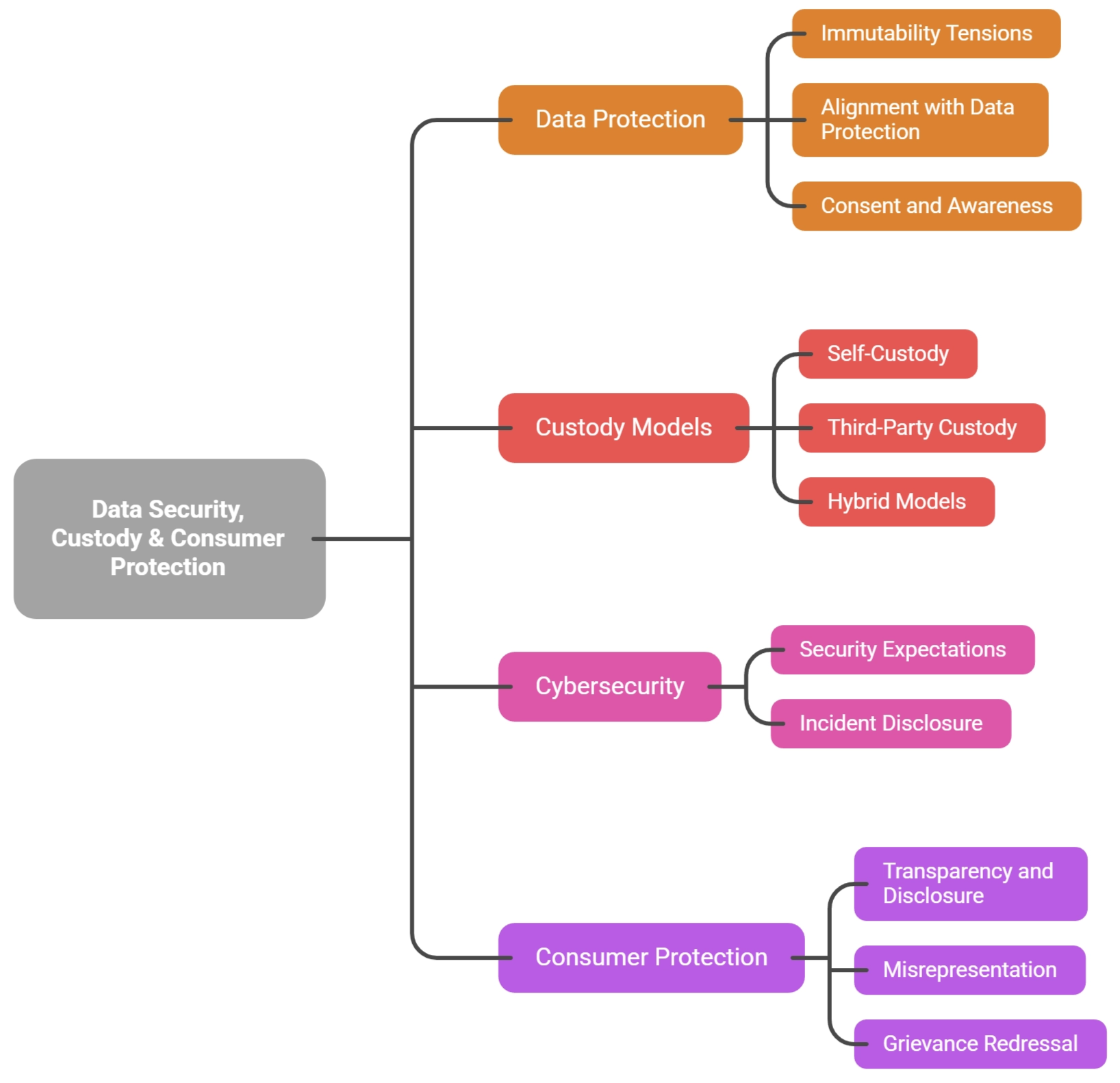
Data security and consumer protection represent cross-cutting concerns that apply to all blockchain-based systems, irrespective of whether they involve crypto assets, enterprise applications, or public-sector use cases.
While blockchain systems are often associated with immutability and transparency, these characteristics can create unique governance challenges when applied in environments involving personal data, financial assets, or consumer interaction. In the absence of clear policy direction, responsibility for risk management may shift disproportionately onto users, without adequate safeguards.
This section outlines directional policy considerations for managing data security, custody and consumer protection in a manner consistent with India's legal framework and socio-economic context.
Data Protection in Blockchain-Based Systems
Immutability and Data Protection Tensions
A defining feature of many blockchain systems is the immutability of recorded data. While this property enhances auditability and trust, it may conflict with data protection principles such as:
Purpose limitation
Data minimization
Rights related to correction or erasure
Policy frameworks must therefore acknowledge that not all data is suitable for on-chain storage, particularly where personal or sensitive information is involved.
Alignment with India's Data Protection Framework
Blockchain deployments operating in India must be considered in light of existing and emerging data protection obligations. Policy direction may emphasize:
Off-chain storage of personal data, with on-chain references or hashes
Clear delineation of data controllers and processors
Purpose-bound data usage
Such approaches allow blockchain systems to preserve functional integrity while aligning with statutory data protection requirements.
As a practical policy direction, personal data should generally not be placed directly on-chain unless there is a strong and specific reason for doing so. In most cases, a better approach would be to keep sensitive or identifiable data off-chain and use blockchain only for references, proofs, logs or verification layers.
This approach does not reduce the usefulness of blockchain. Instead, it helps preserve its benefits while reducing unnecessary conflict with privacy, accountability and user protection concerns.
Consent and User Awareness
Consent mechanisms in blockchain-based systems require special attention, as decentralization may obscure responsibility for obtaining, managing and revoking consent.
Policy considerations may include:
Clear disclosure of how user data is handled
Mechanisms to prevent unintended data exposure
User education regarding the implications of immutable records
Custody Models and Risk Allocation
Overview of Custody Arrangements
Custody in blockchain contexts refers to the control and safeguarding of cryptographic keys that enable access to digital assets or system functions. Common custody models include:
Self-custody by individual users
Third-party custodial services
Hybrid or shared-control models
Each model presents distinct risk profiles and policy implications.
Self-Custody and User Responsibility
Self-custody empowers users with direct control but also exposes them to:
Irrecoverable loss
Operational errors
Security breaches
Policy frameworks may need to consider whether additional safeguards, disclosures, or educational requirements are appropriate when services rely heavily on self-custody models.
Third-Party Custody and Intermediary Risk
Where custody is provided by intermediaries, policy considerations may include:
Minimum security standards
Segregation of customer assets
Transparency around operational practices
Clear liability frameworks
Such considerations aim to reduce systemic risk and enhance consumer trust, without mandating uniform technical solutions.
Where third-party custody is involved, policy should place particular importance on clarity of responsibility. Users should not be left uncertain about who is holding assets, how those assets are being managed, whether customer assets are separated from business assets, and what happens in the event of operational failure, misuse or insolvency.
Even where technical models differ, policy can still expect basic standards of transparency, risk disclosure, operational discipline and fair allocation of responsibility. These are essential to building trust in custodial arrangements.
Cybersecurity and Operational Safeguards
Security Expectations
Blockchain-based systems, particularly those involving financial value or personal data, may be subject to heightened cybersecurity expectations. Policy direction may encourage:
Secure key management practices
Regular security assessments
Incident response planning
Rather than prescribing specific technologies, policy frameworks may focus on outcome-oriented security standards.
Incident Disclosure and Accountability
Given the irreversible nature of many blockchain transactions, timely disclosure of security incidents is critical. Policy considerations may include:
Disclosure timelines
User notification requirements
Coordination with relevant authorities
Such measures support accountability and consumer protection without inhibiting innovation.
Cybersecurity in blockchain-based systems should also be understood broadly. Risk does not arise only from ordinary system breaches, but also from flaws in smart contracts, weak key management, dependence on external data feeds, bridge vulnerabilities, and failures in governance or upgrade mechanisms.
A useful policy approach should therefore avoid treating blockchain security as a narrow technical matter. It should recognize that operational resilience depends on the whole system design, including code, infrastructure, governance and user interaction.
Consumer Protection and Market Conduct
Transparency and Disclosure
Consumers engaging with blockchain-based services often face information asymmetry. Policy frameworks may therefore emphasize:
Clear communication of risks
Transparent explanation of system functionality
Disclosure of fees, limitations and potential losses
These measures help ensure informed participation.
Misrepresentation and Unfair Practices
Blockchain and crypto markets have seen instances of misleading claims regarding:
Returns
Security guarantees
Regulatory status
Policy direction may support mechanisms to address misrepresentation and unfair practices, particularly where services target retail consumers.
Grievance Redressal and Recourse
Decentralized systems can complicate traditional grievance mechanisms. Policy considerations may explore:
Minimum expectations for dispute resolution
Clarity on points of contact for consumer complaints
Role of intermediaries in facilitating redress
One of the recurring weaknesses in blockchain-based consumer environments is the absence of a clear point of responsibility when something goes wrong. Even where systems are partly decentralized, users often interact through identifiable interfaces, service providers, issuers, custodians or promoters.
Policy should therefore encourage a clear allocation of responsibility for complaint handling, consumer communication and redress support wherever users are being onboarded, serviced or commercially engaged through identifiable actors.
Balancing Innovation and Protection
A central challenge for policymakers is balancing innovation enablement with consumer and data protection. Overly restrictive requirements may discourage experimentation, while insufficient safeguards may expose users to harm.
This framework therefore emphasizes:
Proportional safeguards
Context-specific application
Iterative refinement through consultation
Open Policy Questions for Consultation
This section intentionally highlights areas requiring stakeholder input:
How should data protection obligations be operationalized in decentralized systems?
What minimum standards are appropriate for custodial services?
How can consumer protection be strengthened without excessive compliance burden?
Where should responsibility lie in hybrid or decentralized models?
These questions will inform subsequent stakeholder consultations and refinements of the framework.
Stakeholder Perspectives
A summary of stakeholder feedback on this section, reviewed by the policy team.
Taxation & Compliance Treatment
Rationale and Policy Context
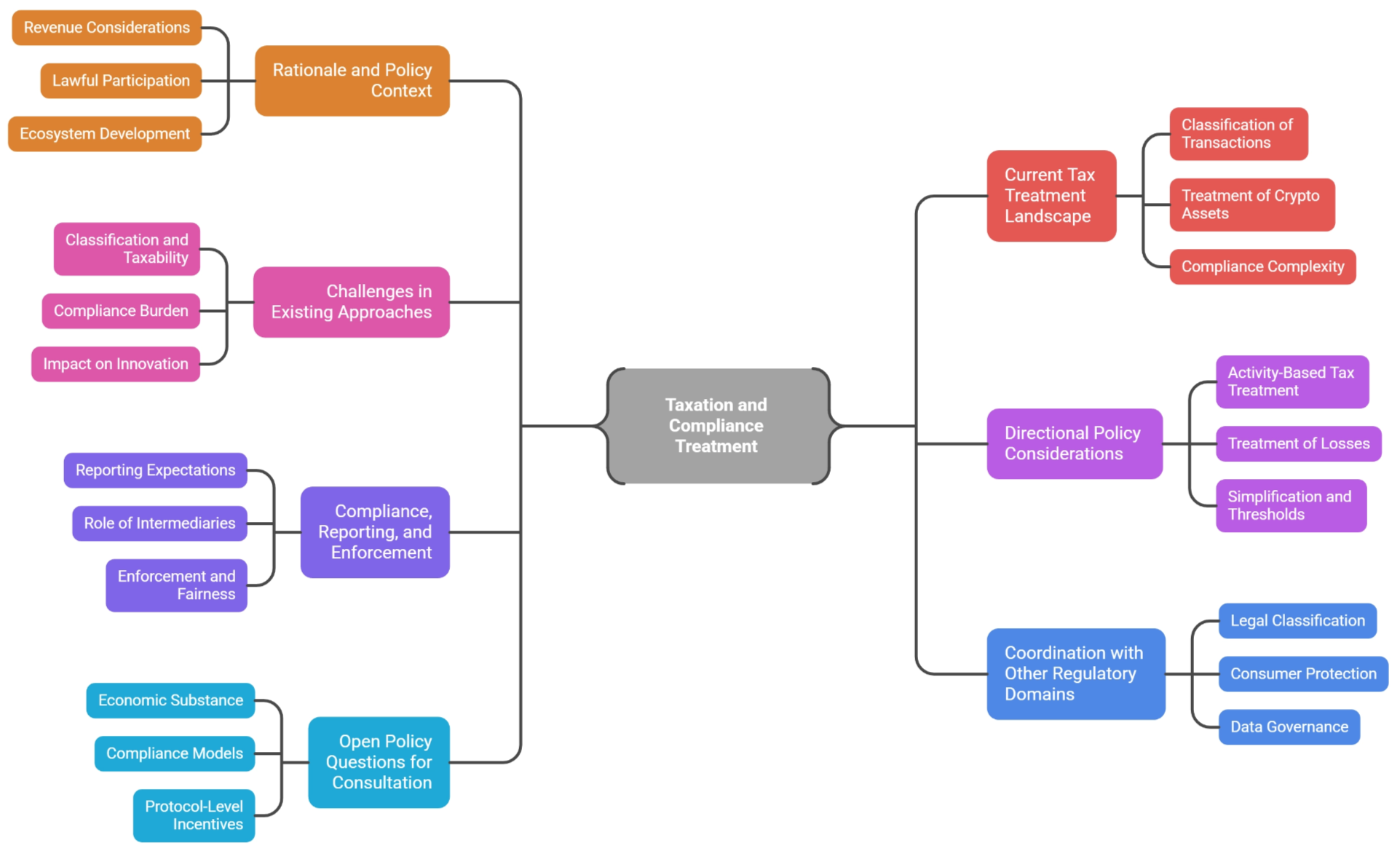
Taxation and compliance represent some of the most immediate and practical interfaces between blockchain-based activities and the State. Clear and predictable tax treatment is essential not only for revenue considerations, but also for enabling lawful participation, reducing compliance friction and fostering long-term ecosystem development.
In the absence of coherent policy direction, taxation measures may be perceived as deterrents rather than instruments of governance, particularly by early-stage enterprises and individual participants. This section therefore explores directional considerations for taxation and compliance in the blockchain and crypto context, without proposing specific tax rates or legislative changes.
Current Tax Treatment Landscape
India has taken steps to bring certain crypto-related activities within the tax net. While this reflects a recognition of economic activity in the sector, current approaches have also raised questions regarding:
Classification of transactions
Treatment of different types of crypto assets
Compliance complexity for individuals and enterprises
From a policy perspective, taxation measures signal the State's intent to regulate economic activity, even where broader legal classification remains under development.
This framework does not seek to reinterpret existing tax provisions, but instead considers structural policy questions that arise from their application.
Challenges in Existing Approaches
Classification and Taxability
A central challenge lies in determining what is being taxed. Crypto-related transactions may involve:
Transfers of value
Access to services
Network participation / grants
Incentives or rewards
Treating all such activity under a single tax category may obscure meaningful differences in economic substance.
One of the reasons tax treatment becomes difficult in this area is that blockchain-based activity does not always reflect the same economic reality. A person may be investing, accessing a service, moving assets internally, receiving protocol-based incentives, or participating in a network in a non-investment capacity. These are not always economically identical, even if they involve digital assets or recorded transfers.
A better policy approach should therefore remain sensitive to economic substance and not assume that every blockchain-related transaction carries the same meaning, intent or compliance significance.
Compliance Burden and Complexity
Participants frequently report difficulty in:
Tracking transaction history across platforms
Valuing assets in volatile markets
Meeting reporting requirements
For startups and small enterprises, compliance costs may be disproportionately high relative to scale and revenue.
Impact on Innovation and Participation
Taxation frameworks that do not differentiate between speculative activity and infrastructure development may unintentionally:
Discourage experimentation
Push activity into informal or offshore channels
Reduce transparency and compliance over time
Directional Policy Considerations
This framework suggests several policy-level considerations that may guide future refinement of taxation and compliance approaches.
Activity-Based Tax Treatment
Rather than focusing solely on asset form, policy may benefit from examining:
Nature of the activity (investment, consumption, infrastructure participation)
Role of the participant (user, developer, intermediary)
Frequency and scale of transactions
Such distinctions may enable more proportionate and comprehensible tax treatment.
Treatment of Losses, Transfers and Incentives
Clarity may be required on issues such as:
Treatment of losses in volatile markets
Intra-network transfers without economic realization
Protocol-level incentives or rewards
Addressing these questions can reduce uncertainty and promote voluntary compliance.
Simplification and Thresholds
Policy frameworks may explore simplification mechanisms, including:
Threshold-based reporting
De minimis exemptions for low-value activity
Streamlined compliance for early-stage enterprises
Such approaches can enhance compliance without undermining fiscal objectives.
Compliance, Reporting and Enforcement
Reporting Expectations
Clear guidance on reporting obligations supports both taxpayers and enforcement authorities. Policy considerations may include:
Standardized reporting formats
Alignment with existing financial disclosure norms
Use of technology to facilitate compliance
As this ecosystem grows, compliance will become more workable if reporting systems are designed to be simple, standardised and technology-friendly. Where possible, policy should encourage structured reporting formats, common data expectations, and tools that reduce duplication and manual effort. This is especially important in environments where users operate across multiple platforms, wallets or service layers. If reporting remains too fragmented or too difficult to interpret, compliance quality may suffer even among actors who are willing to comply
Role of Intermediaries
Intermediaries may play a role in:
Information reporting
Transaction monitoring
User education
Policy frameworks may consider how responsibilities can be appropriately distributed without imposing excessive operational burden.
Enforcement and Fairness
Effective enforcement requires clarity, proportionality and consistency. Policy design may seek to:
Avoid retroactive uncertainty
Ensure fairness across participant categories
Maintain alignment with broader financial compliance systems
Coordination with Other Regulatory Domains
Taxation does not operate in isolation. Its effectiveness and legitimacy are influenced by:
Legal classification of crypto assets
Consumer protection measures
Data governance frameworks
Policy coherence across these domains reduces friction and enhances trust.
Open Policy Questions for Consultation
This section highlights issues for stakeholder engagement:
How can tax treatment reflect economic substance without excessive complexity?
What compliance models best support innovation while ensuring accountability?
How should protocol-level incentives be treated for tax purposes?
What role should technology play in simplifying compliance?
These questions are intentionally left open for structured consultation.
Stakeholder Perspectives
A summary of stakeholder feedback on this section, reviewed by the policy team.
Innovation Enablement & Incentive Structures
Why Innovation Enablement Requires Policy Attention
Blockchain technologies have the potential to support innovation across multiple domains, including financial services, governance, supply chains, identity and public infrastructure. However, in the absence of clear and supportive policy signals, innovation may be constrained not by technical limitations, but by regulatory uncertainty.
Policy frameworks that focus exclusively on risk mitigation may inadvertently:
Discourage legitimate experimentation
Push innovation into informal or offshore environments
Reduce transparency and accountability
This section therefore emphasizes the role of policy in creating enabling conditions for responsible blockchain innovation, while remaining aligned with broader public interest objectives.
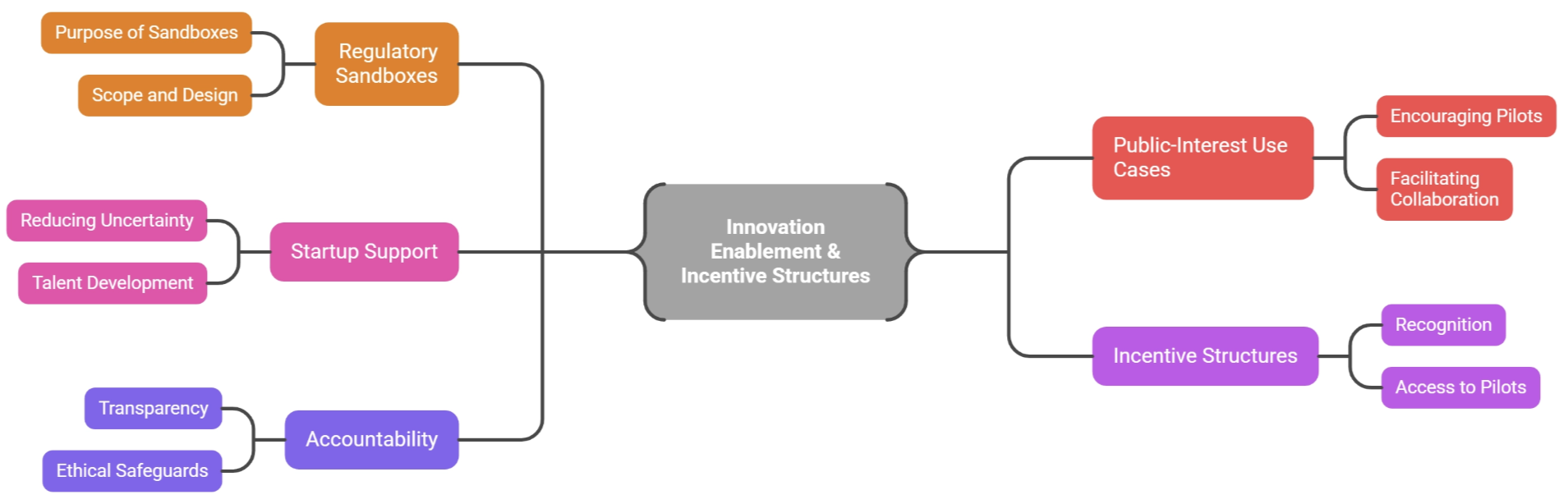
Regulatory Sandboxes and Controlled Experimentation
Purpose of Sandboxes
Regulatory sandboxes can provide structured environments in which innovators test new models under regulatory oversight. For blockchain-based systems, sandboxes may support:
Early-stage experimentation
Evidence gathering for policy refinement
Risk identification prior to wider deployment
Scope and Design Considerations
Policy frameworks may consider sandboxes that:
Are time-bound and outcome-oriented
Apply proportionate safeguards
Allow participation by startups, enterprises and public-sector actors
Rather than focusing solely on financial applications, sandboxes may also support non-financial and public-interest use cases.
In the Indian context, controlled experimentation can be more effective when it is linked to real institutional pathways rather than discussed only in theory. Different types of blockchain experimentation may need different environments. Financial and tokenisation-linked models may require more tightly supervised settings, while non-financial and public-interest use cases may benefit from separate pilot pathways involving relevant sectoral institutions. Recognising this distinction can help policy avoid a one-size-fits-all sandbox approach and make experimentation more practical and credible.
Supporting Public-Interest and Infrastructure Use Cases
Blockchain applications in areas such as governance, public records, welfare delivery and transparency may generate social value that differs from purely commercial activity.
Policy considerations may include:
Encouraging pilots in public-sector contexts
Facilitating collaboration between government and innovators
Ensuring that public-interest use cases are not burdened by requirements designed for speculative markets
Such differentiation allows policy to reflect context and impact, rather than applying uniform treatment. Public-interest adoption should not be seen only as a future possibility. It can also be used as a practical policy tool to understand which blockchain models actually create value in the Indian context. Carefully designed pilots in areas such as records, traceability, certifications, public service delivery, or transparency systems can generate evidence that is more useful than abstract debate alone.
This is particularly important because it allows policy to be informed by outcomes, not assumptions. It also helps distinguish between use cases that are genuinely useful and those that are primarily speculative or hype-driven
Startup, Developer and Ecosystem Support
Reducing Regulatory Uncertainty for Startups
Early-stage enterprises often face disproportionate risk from regulatory ambiguity. Policy frameworks may seek to:
Provide clearer guidance on permissible activities
Reduce compliance friction at early stages
Encourage voluntary disclosure and engagement
Talent, Skills and Research Development
Long-term innovation capacity depends on:
Skilled developers and researchers
Academic–industry collaboration
Open research and experimentation
Policy direction may encourage support for:
Research grants
Educational initiatives
Open-source development
Incentive Structures and Market Signals
Incentives need not be financial alone. Policy frameworks may consider:
Recognition of compliant innovation
Access to public-sector pilots
Preferential consideration in government programs
Such incentives signal policy intent without creating distortions or dependencies.Market signals can also be shaped through public procurement, pilot participation, standards alignment and institutional recognition. In some cases, these forms of support may be more useful than direct financial incentives because they create legitimacy, demand visibility and early implementation opportunities for compliant innovators. A well-designed policy framework should therefore consider how government and public institutions can act not only as regulators, but also as thoughtful facilitators of credible experimentation.
Balancing Innovation with Accountability
Innovation enablement must be accompanied by:
Transparency
Ethical safeguards
Accountability mechanisms
Policy frameworks may emphasize that innovation does not exempt actors from responsibility, but rather benefits from clear expectations and trust-building measures.
Open Policy Questions for Consultation
This section identifies areas for stakeholder input:
How should sandboxes be structured to support learning without creating loopholes?
What incentives best support responsible innovation in the Indian context?
How can public-interest use cases be differentiated from speculative activity?
What role should government play as an early adopter or facilitator?
These questions will inform refinement of innovation-focused policy mechanisms.
Stakeholder Perspectives
A summary of stakeholder feedback on this section, reviewed by the policy team.
Institutional & Governance Architecture
Importance of Institutional Coordination
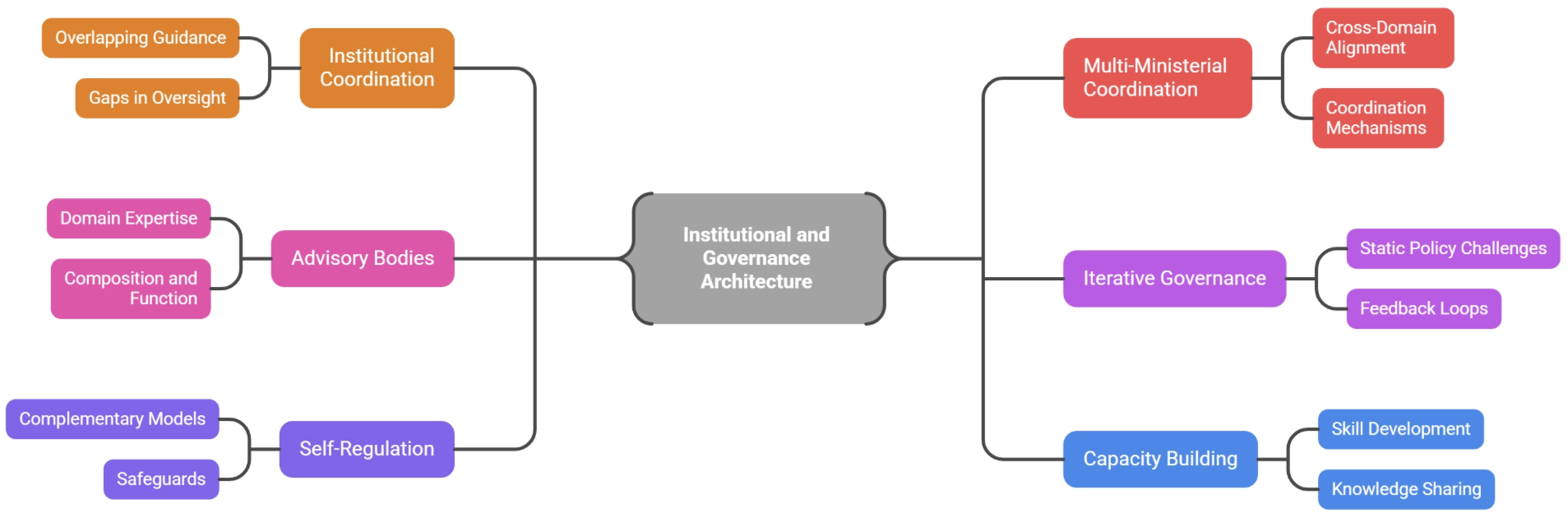
Blockchain technologies and crypto-related activities cut across multiple regulatory and policy domains, including finance, information technology, data protection, consumer protection and innovation policy. As a result, effective governance in this area depends less on the authority of any single institution and more on coordination across institutions.
Without clear coordination mechanisms, policy outcomes may include:
Overlapping or inconsistent regulatory guidance
Gaps in oversight and enforcement
Uncertainty for regulated entities and users
This section outlines directional considerations for institutional and governance arrangements that support coherent, adaptive policy development.
Multi-Ministerial and Cross-Regulatory Coordination
Need for Cross-Domain Alignment
Blockchain-based activities often engage multiple regulatory mandates simultaneously. For example, a single application may raise:
Financial compliance questions
Data protection concerns
Consumer protection issues
Innovation policy considerations
Policy frameworks may therefore benefit from formal or informal coordination mechanisms that enable dialogue and alignment across ministries and regulators.
Possible Coordination Mechanisms
Without prescribing specific institutional forms, policy considerations may include:
Inter-ministerial working groups
Joint consultation processes
Shared policy principles or guidance documents
Such mechanisms can reduce fragmentation while respecting existing statutory mandates.
For practical purposes, institutional coordination may work best when it operates at more than one level. One level may focus on policy alignment across ministries and regulators. A second may focus on technical and market expertise. A third may focus on ongoing public consultation, review and transparency.
This layered approach can help ensure that coordination is not reduced to occasional discussion alone. It creates a structure through which policy thinking, technical understanding and public accountability can develop together.
Role of Advisory and Expert Bodies
Value of Domain Expertise
Given the technical and economic complexity of blockchain systems, policy formulation may benefit from ongoing expert input beyond traditional regulatory processes.
Advisory bodies may provide:
Technical insight
Market intelligence
Comparative policy perspectives
Composition and Function
Policy frameworks may consider advisory mechanisms that:
Include technical, legal, economic and social perspectives
Reflect diversity across industry, academia and civil society
Operate transparently and on a consultative basis
Such bodies need not exercise regulatory authority; their value lies in informing decision-making.
Iterative and Adaptive Governance
Moving Beyond Static Policy
Blockchain technologies evolve rapidly, making static policy approaches difficult to sustain. Adaptive governance recognizes that:
Early policy may require revision
Pilot outcomes provide valuable learning
Stakeholder feedback improves legitimacy
Policy frameworks may therefore emphasize periodic review and iteration rather than one-time rulemaking.
Feedback Loops and Learning Mechanisms
Directional considerations may include:
Structured review cycles
Feedback channels for regulated entities and users
Integration of sandbox learnings into broader policy
These mechanisms help ensure that policy remains responsive and evidence-based.
Role of Self-Regulation and Co-Regulation
Complementary Governance Models
In some contexts, industry-led standards or codes of conduct may complement formal regulation. Such approaches may:
Encourage responsible behavior
Support early-stage governance
Reduce enforcement burden
Policy frameworks may explore co-regulatory models, where self-regulation operates within clearly defined public-interest boundaries.
Safeguards and Accountability
Any self- or co-regulatory approach must be accompanied by:
Transparency
Oversight mechanisms
Clear escalation pathways
This ensures that voluntary standards enhance, rather than undermine, regulatory objectives.
Institutional Capacity Building
Effective governance depends on institutional capacity. Policy considerations may include:
Skill development within regulatory bodies
Knowledge-sharing across institutions
Engagement with international best practices
Capacity building supports informed decision-making and effective enforcement.
Capacity building supports informed decision-making and effective enforcement. Capacity building should also include the ability to understand offshore-facing activity, tokenised business models, custody structures, and the governance realities of systems that may appear decentralized on paper but function through identifiable control points in practice.
Without this level of institutional understanding, policy may remain formally broad but operationally weak. Capacity is therefore not only about technical literacy, but also about regulatory interpretation, market awareness and coordinated enforcement readiness.
Open Governance Questions for Consultation
This section identifies issues for stakeholder discussion:
What coordination mechanisms best suit India's institutional structure?
How can advisory input be structured to add value without capture?
What balance should be struck between regulation and self-governance?
How can adaptive governance be operationalized in practice?
These questions will guide further consultation and refinement.
Stakeholder Perspectives
A summary of stakeholder feedback on this section, reviewed by the policy team.
Phased Implementation Roadmap
Rationale for a Phased Approach
Blockchain technologies and crypto-related activities evolve rapidly and their societal, economic and systemic impacts may only become visible over time. A phased implementation approach allows policymakers to:
Manage uncertainty
Learn from real-world deployment
Adjust regulatory responses based on evidence
Rather than a single comprehensive rollout, phased implementation supports progressive policy maturation, balancing innovation with risk management.
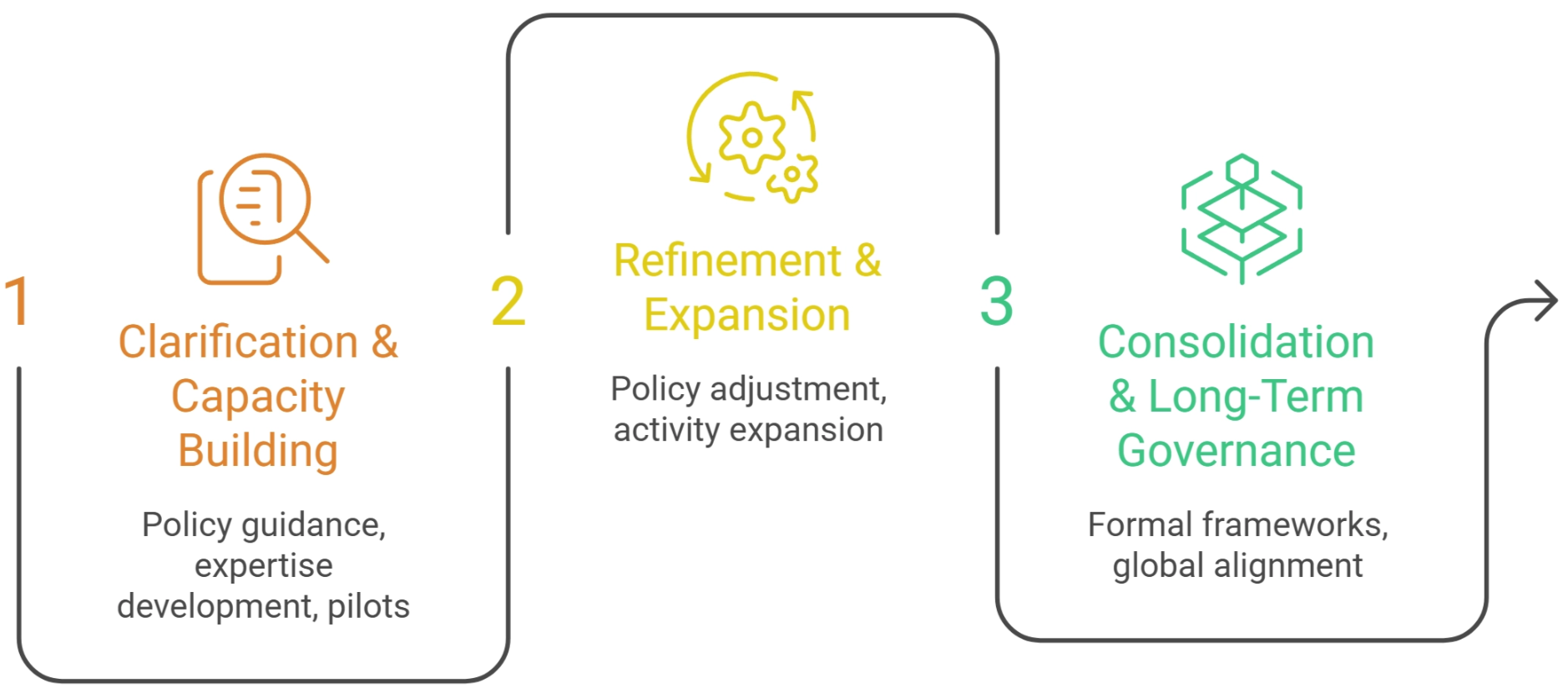
Phase I: Clarification and Capacity Building (0–12 Months)
Policy Clarification and Guidance
In the short term, emphasis may be placed on:
Clarifying policy intent and scope
Issuing guidance documents where ambiguity exists
Communicating regulatory expectations clearly to stakeholders
Such clarification can significantly reduce uncertainty without requiring legislative change.
Phase I should ideally produce visible and practical outputs, not only broad discussion. These may include a clearer classification note, priority areas for pilot testing, a more refined understanding of high-risk versus low-risk activity, and stronger internal capacity across relevant public institutions. Early clarity of this kind can reduce uncertainty significantly, even before any major legislative or regulatory reform takes place.
Institutional Capacity Development
Early efforts may also focus on:
Building internal expertise within relevant institutions
Facilitating knowledge-sharing across ministries and regulators
Engaging with technical experts and research bodies
Capacity development enhances regulatory effectiveness and confidence.
Pilot Programs and Sandboxes
Phase I may include:
Launch of regulatory sandboxes
Pilot projects in public-interest domains
Controlled experimentation under oversight
These initiatives provide evidence to inform subsequent policy refinement.
Phase II: Refinement and Expansion (1–3 Years)
Policy Refinement Based on Evidence
Insights from Phase I may inform:
Adjustment of classifications and definitions
Refinement of compliance and reporting expectations
Reassessment of consumer protection measures
This phase emphasizes learning-driven governance.
Expansion of Permissible Activities
As clarity improves, policymakers may consider:
Expanding the scope of permitted activities
Supporting broader adoption of compliant models
Encouraging ecosystem maturation
Expansion is contingent on demonstrated risk management and compliance.
Phase II can build on evidence gathered during the first phase by refining definitions, clarifying accountability expectations, and identifying where more formal guidance is genuinely needed. This stage should be driven by observed outcomes, not by assumptions carried over from early debate. A phased approach will only work if each stage produces learning that is then carried forward in a visible and disciplined way.
Phase III: Consolidation and Long-Term Governance (Beyond 3 Years)
Policy Consolidation
Over the longer term, policy elements may be consolidated into:
More formal regulatory frameworks
Harmonized guidance across domains
Stable compliance expectations
Consolidation supports predictability and market confidence.
Alignment with Global Developments
Blockchain and crypto markets operate globally. Long-term governance may therefore include:
Monitoring international standards
Engaging in cross-border policy dialogue
Ensuring interoperability and compatibility
Global alignment enhances competitiveness and cooperation.
Long-term consolidation should not be treated as an automatic move toward a single rigid framework. In some areas, formalization may be appropriate. In others, ongoing guidance, sector-specific treatment or adaptive oversight may remain the better course. The aim should be durable clarity, not unnecessary rigidity.
Continuous Review and Adaptation
Across all phases, continuous review mechanisms may include:
Periodic policy assessments
Stakeholder feedback loops
Review of technological and market developments
Adaptation ensures that policy remains relevant and effective.
Risk Management Across Phases
A phased approach also supports proactive risk management by:
Identifying emerging risks early
Avoiding irreversible policy commitments
Allowing corrective action where needed
This reduces the likelihood of unintended consequences.
Stakeholder Perspectives
A summary of stakeholder feedback on this section, reviewed by the policy team.
Risks, Trade-offs & Open Policy Questions
Purpose of This Section
Policy frameworks addressing emerging technologies must acknowledge uncertainty. Blockchain and crypto-related systems present evolving technical, economic and social dynamics and policy responses inevitably involve trade-offs.
This section does not seek to resolve all such tensions. Instead, it:
Identifies key risks associated with different policy approaches
Highlights trade-offs inherent in regulatory decision-making
Surfaces unresolved questions for structured consultation
Explicit recognition of these factors strengthens policy legitimacy and supports adaptive governance.
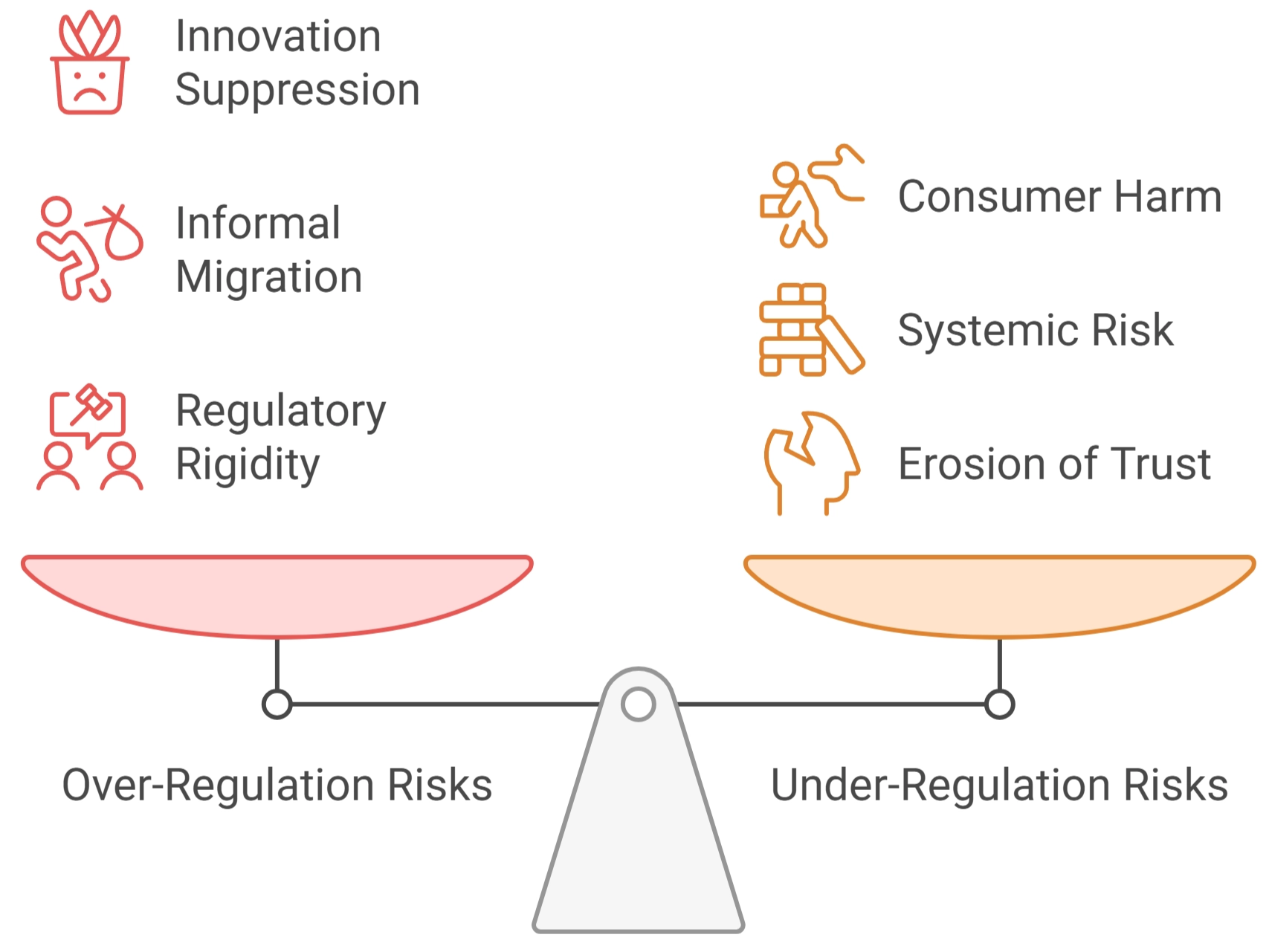
Risks of Over-Regulation
Overly restrictive or premature regulation may produce unintended consequences, including:
Innovation Suppression
Discouragement of early-stage experimentation
Reduced participation by startups and researchers
Slower development of domestic technical capability
Informal or Offshore Migration
Movement of activity to less regulated jurisdictions
Reduced transparency and oversight
Loss of economic and intellectual capital
Regulatory Rigidity
Difficulty adapting to technological change
Increased compliance burden without commensurate risk reduction
These risks highlight the importance of proportionate and phased policy design.
Risks of Under-Regulation
Conversely, insufficient regulatory attention carries its own risks:
Consumer Harm
Exposure to fraud, misrepresentation and operational failures
Limited avenues for redress
Systemic and Financial Risk
Concentration of risk in intermediaries
Market instability and contagion effects
Erosion of Trust
Loss of public confidence in digital systems
Reputational impact on legitimate innovation
Under-regulation may undermine both public interest and long-term ecosystem growth.
Under-regulation may also create risks in areas where users rely on claims of stability, backing, safety or operational soundness without adequate visibility into how such claims are being managed. Where digital assets or token-based systems create expectations of redeemability, reserve support, or secure custody, weak oversight can quickly translate into concentrated harm and erosion of trust.
Key Policy Trade-offs
Clarity vs Flexibility
Clear rules provide certainty but may limit adaptability. Flexible approaches allow learning but may prolong ambiguity.
Centralized Oversight vs Decentralized Models
Traditional regulatory structures may not map cleanly onto decentralized systems, raising questions of accountability and enforcement.
Innovation Speed vs Consumer Protection
Faster innovation can increase risk exposure, while strong safeguards may slow adoption.
Recognizing these trade-offs enables more informed and transparent policy choices.
Another important trade-off lies between formal decentralization and practical accountability. A system may appear decentralized in design, yet still depend heavily on identifiable actors for governance, liquidity, user access, promotion, upgrades or treasury control. Policy must therefore be careful not to confuse technical form with real-world responsibility.
Areas Requiring Further Evidence
Several areas require deeper analysis and stakeholder input before policy positions can be refined, including:
Economic impact of different classification approaches
Effectiveness of sandbox and pilot programs
Consumer behavior and risk perception
Long-term implications of decentralized governance models
Evidence-based policymaking depends on continued research and data collection.
Open Policy Questions for Consultation
This framework intentionally leaves several questions open for stakeholder engagement:
How should regulatory responsibility be allocated in decentralized systems?
What minimum safeguards are appropriate for retail participants?
How can policy differentiate between speculative activity and infrastructure innovation?
What mechanisms best support adaptive governance over time?
These questions will guide structured consultation and iterative refinement.
Summary of Policy Intent
This draft policy framework has sought to articulate a coherent, balanced and adaptive approach to governing blockchain technologies and crypto-related activities in India. Rather than advocating for rigid regulatory prescriptions, it has focused on:
Clarifying policy considerations
Identifying core regulatory domains
Establishing guiding principles for decision-making
By addressing crypto asset legality and classification, data security and consumer protection, taxation and compliance, innovation enablement, institutional coordination and phased implementation, the framework provides a structured lens through which policy choices can be evaluated.
Emphasis on Consultation and Iteration
A central premise of this framework is that effective blockchain policy cannot be static. The technologies, markets and use cases involved are evolving and policy responses must evolve alongside them.
Accordingly, this draft is explicitly positioned as:
A starting point for dialogue
A reference for structured consultation
A basis for evidence-led refinement
Subsequent stages of this project will focus on engaging stakeholders, gathering empirical insights and refining policy positions based on real-world considerations.
Role of Stakeholders in Refinement
The success of any policy framework depends on meaningful participation from:
Policymakers and regulators
Industry and technology practitioners
Legal and academic experts
Civil society and consumer representatives
Stakeholder engagement will play a critical role in:
Validating assumptions
Identifying unintended consequences
Prioritizing policy interventions
This framework is designed to incorporate such feedback transparently and systematically.
Towards Responsible and Inclusive Blockchain Governance
Blockchain technologies offer opportunities to enhance transparency, efficiency and trust across a range of domains. At the same time, they introduce new risks and governance challenges.
A responsible policy approach must therefore:
Enable innovation while safeguarding public interest
Promote clarity without sacrificing adaptability
Encourage participation while ensuring accountability
This framework aims to contribute to such an approach, aligned with India's broader digital governance objectives.
Next Steps
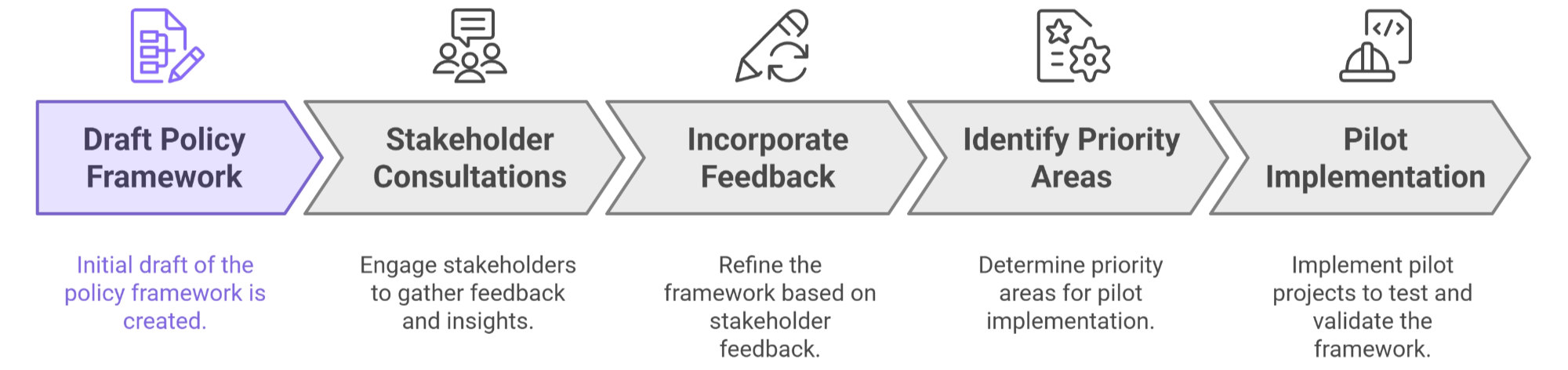
The immediate next steps following this draft include:
Structured stakeholder consultations to review and refine the framework
Incorporation of feedback into revised drafts
Identification of priority areas for pilot implementation
Over time, insights from these processes may inform more formal policy instruments, guidance, or regulatory initiatives.
The next stage of refinement should focus on areas where additional clarity will have the greatest practical value. These include classification logic, accountability in hybrid or decentralized systems, design expectations for data protection and custody, structured experimentation pathways, and more coordinated approaches to cross-domain and cross-border supervision.
This will help ensure that the framework develops in a focused and usable manner, rather than becoming too broad to guide real policy choices.
Closing Note
This framework reflects an intent to engage, learn and adapt, rather than to prescribe or constrain. By approaching blockchain policy as an evolving governance challenge rather than a fixed regulatory problem, India can position itself to harness the benefits of these technologies while managing their risks responsibly.
Summary under review
The consultation summary for this section is being reviewed before publication.